
Do you know the difference between sharing your truth through the filter of pain and sharing from love?
Lately I’ve noticed this trend of people claiming they are “speaking their truth” when they are expressing their beliefs toward another party (which presumably feels differently).
These shares, though they can feel empowering in the moment, are served with the energy of judgment, malice, spite, accusation or resentment. It can be felt, even if delivered in what feels like plain language, and it fuels the fire of adversity between the two groups or people.
We think maybe, if we share our passion or outrage loud enough, or use the right statistic when we share, the opposing party will finally hear us. They’ll understand. They’ll come around, just as we’ve always hoped.
Unfortunately, I’ve found that this rarely works.
If emotionally-tinged self-expression only fans the flames of the burning bridge between you, what is the purpose of continuing to argue your point? Do you really think your share will fix the issue at hand by FINALLY convincing the other person to change?
Let’s be real. The best approach to changing a situation is by changing YOUR behavior, and taking action in a different way to protect yourself and possibly preserve the relationship between you and the other. And both parties must first be in a receptive state of emotional groundedness and empathetic understanding before a productive conversation can take place.
I’ve found these prompts to be helpful before engaging…
Am I Sharing From a Place of Pain?
Ask yourself, is my intention to:
– prove a point
– illicit a specific reaction
– inflict pain
– push someone away/pull someone closer
– relieve my own stress
Sharing from pain says, “I need you to change in order to love you.”
Your Intention Has Energy
Even if your words are nonviolent, your intentions can be sensed through the energetic communication and body language between you and the person with which you’re interacting.
Before you share, as yourself, is this motivated by anxiety, guilt, shame, anger or sadness? Are these feelings above a 5 on a scale of 1-10, (ten being the most extreme)?
If they’re above 5, wait until your feelings de-escalate before sharing.
Self-expression motivated by intense emotions may feel cathartic, but it rarely brings peace in a relational dynamic unless the other person is VERY open to receiving you (also rare when conversation is heated).
Instead, you wait until you feel grounded in our own energy and able to respond and hear without losing your mental/emotional balance.
Stability is the most important experience we can ever cultivate, and it can leave us quickly if we’re not mindful of protecting it. When we’re stable, we can share from a place of love and empathy.
Share from Love
Sharing from love means your motivation is to:
– understand another person
– help another understand you
– set/maintain a boundary
– ask for clarity
– learn because you’re curious
– express how you’re feeling
Sharing from love seeks simply to understand. It accepts someone as they are, meets them where they’re at, and gives them the chance to understand you.
You inform someone of the unmet need behind your emotion, and give them the opportunity to choose how they want to react. This doesn’t guarantee they’ll react the way you want. It DOES give you the chance to be seen, heard, and to decide what to do after you witness their reaction.
Use Nonviolent Communication
When it comes to conveying feelings, it’s important to use nonviolent communication.
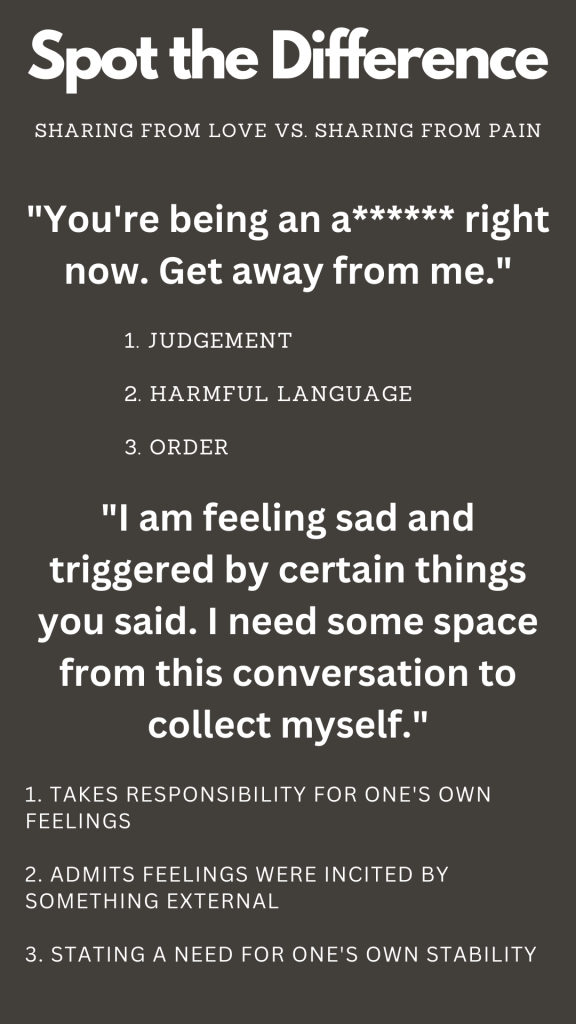
In order to keep from triggering the other person, it is helpful to make your shares about YOU, your needs and your feelings.
So let’s say you’ve checked all the boxes. You’re ready to share from a loving place, and you’re using nonviolent communication. There’s one more thing to check — is the other person open to receiving you with same understanding, clarity and curiosity for which you strive?
Every party in a relationship is proportionately responsible for the interface between the people involved. If your audience can’t really LISTEN to what you say, but only looks for things to attack or defend, they are not really an audience at all. It’s like trying to pet an angry or threatened animal.
If you’ve delivered your message as purely as you could and the person still won’t listen empathetically, you can still take care of yourself.
Here’s how:
- Take some space. You’ve got some emotional processing and reflecting to do.
- Consult a trusted, mindful friend, healer, or licensed therapeutic practitioner to hold space for you as you process your feelings about it. Eventually, you’ll feel safe and healed again and you will learn something about how (and how frequently) you want to interact and conduct yourself with others moving forward.
- Decide how you will approach this person moving forward.
- Commit to these changes and don’t look back.
Remember that you can ALWAYS protect your internal peace and stability without needing someone else to change, another person’s apology, or needing that person’s feelings to be the same as our own.
In order to do this, you must decide that your inner peace is more important than being right, being liked, or being validated or understood. In some cases, you must decide to walk away entirely.
This is one of the most challenging decisions to make when relating to another person. But when you reach that point, you have learned the beautiful art of self-respect.
Biiiiig Disclaimer: I post this noticing a great deal of irony. I take issue with sharing from pain, and I also realize and acknowledge all the times I’ve been guilty of it myself. All of the entries I write on this blog explore these topics for collective growth, and additionally serve me a big dose of my own medicine. My intention when writing about these topics is to fully integrate my own self-reflections and in order to become a better version of myself. I hope you find this helpful, as it has helped me become a healthier communicator.
 siobhanbarton.com
Leave a Reply